The DSA's Cuba Problem
The Democratic Socialists of America Travel to Cuba and Happily Meet With the Island’s Jailers.

On 25 November - the International Day for the Elimination of Violence Against Women - Amnesty International released a report focusing on Cuba that included the following:
Women human rights defenders, activists, and journalists suffer human rights violations such as arbitrary detentions, illegal interrogations, undue surveillance, unjust criminalization, and due process violations, with patterns differentiated by their gender….The repression exercised against women by state agents constitutes a form of institutional gender-based violence. Women suffer specific forms of repression, such as the use of male agents in operations to intimidate them; forced nudity and invasive body searches during arrests; stigmatization by attacking aspects of their gender and physical appearance; and discrimination based on age and sexual orientation…Defamation campaigns with direct references to their sex lives, physical appearance, and romantic relationships, “acts of repudiation” using misogynistic language, and the public exposure of personal data constitute forms of symbolic and psychological violence that seek to stigmatize and delegitimize women for their activism.
Such information about the reactionary nature of the dictatorship that has ruled Cuba since 1959 - and which, for all its radical rhetoric and ideological trappings, has now curdled into little more than clusters of Communist Party and military elites guarding their hotels from an ever-more disenfranchised populace - would come as little surprise to those who have observed the island in recent years. According to the Madrid-based human rights organization Prisoners Defenders, there are now nearly 1,200 political prisoners in Cuba, and the island’s landscape as 2025 draws to a close is one of material deprivation and draconian state repression that perhaps can only be paralleled by the regimes in Nicaragua and Venezuela in the hemisphere. After the Cuban government - or what masquerades as it - engaged in mass arrests following large-scale 2021 demonstrations, Human Rights Watch detailed how it had “systematically engaged in arbitrary detention, ill-treatment of detainees, and abuse-ridden criminal prosecutions in response to overwhelmingly peaceful anti-government protests.”
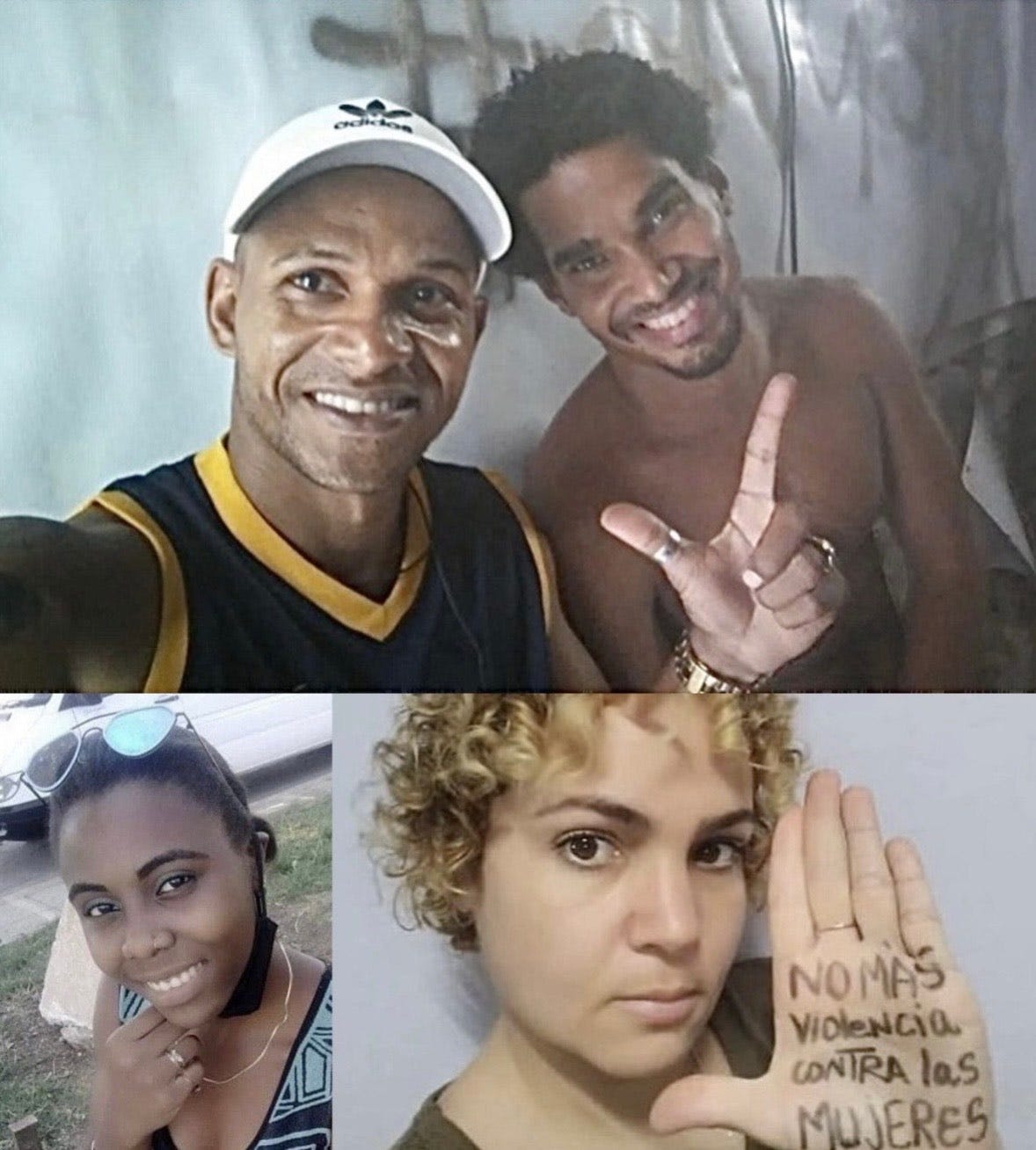
Those detained by the government, currently ostensibly led by President Miguel Díaz-Canel but over which the families of former rulers Fidel and Raúl Castro still exercise significant control, include some of the island’s leading lights of music, art, literature and journalism, along with feminists, LGBTQ activists and hundreds of ordinary citizens. The rapper Maykel “Osorbo” Castillo Pérez, designated a prisoner of conscience by Amnesty International, is currently serving nine years in prison for “contempt” and “public disorder,” but his real crime was to dare to stand up to the regime’s abuses and hypocrisy in his music, most notably as part of the collective behind the 2021 song “Patria y Vida.” The performance artist Luis Manuel Otero Alcántara - who grew up in Cerro, one of Havana’s poorest neighborhoods and in 2020 observed to me that “the Cuban regime is weighted on the basis of white men, macho, patriarchal white men” - is jailed under the same “contempt” and “public disorder” charges as Castillo Pérez and has also begin designated a prisoner of conscience. Convicted of “public disorder,” “contempt” and “resistance,” the poet and activist María Cristina Garrido Rodríguez also remains in jail. The Youtuber Sulmira Martínez Pérez, better known as “Salem,” was thrown in jail for “contempt” and “crimes against the constitutional order” for calling for nonviolent protests against the government. Last year, PEN International issued an alert about how “for six decades, the Cuban authorities have systematically sought new ways to suppress any and all dissent, particularly targeting freedom of expression…In recent years, the repression has ramped up to keep up with the growth of internet and social media platforms that serve as outlets for creatives in Cuba.” This past September, the organization described how “Cuban writers and artists continue to face relentless persecution for their books, articles, and protests. The government’s systematic efforts to silence them reveal the profound fear of free expression that lies at the heart of repression in Cuba.”
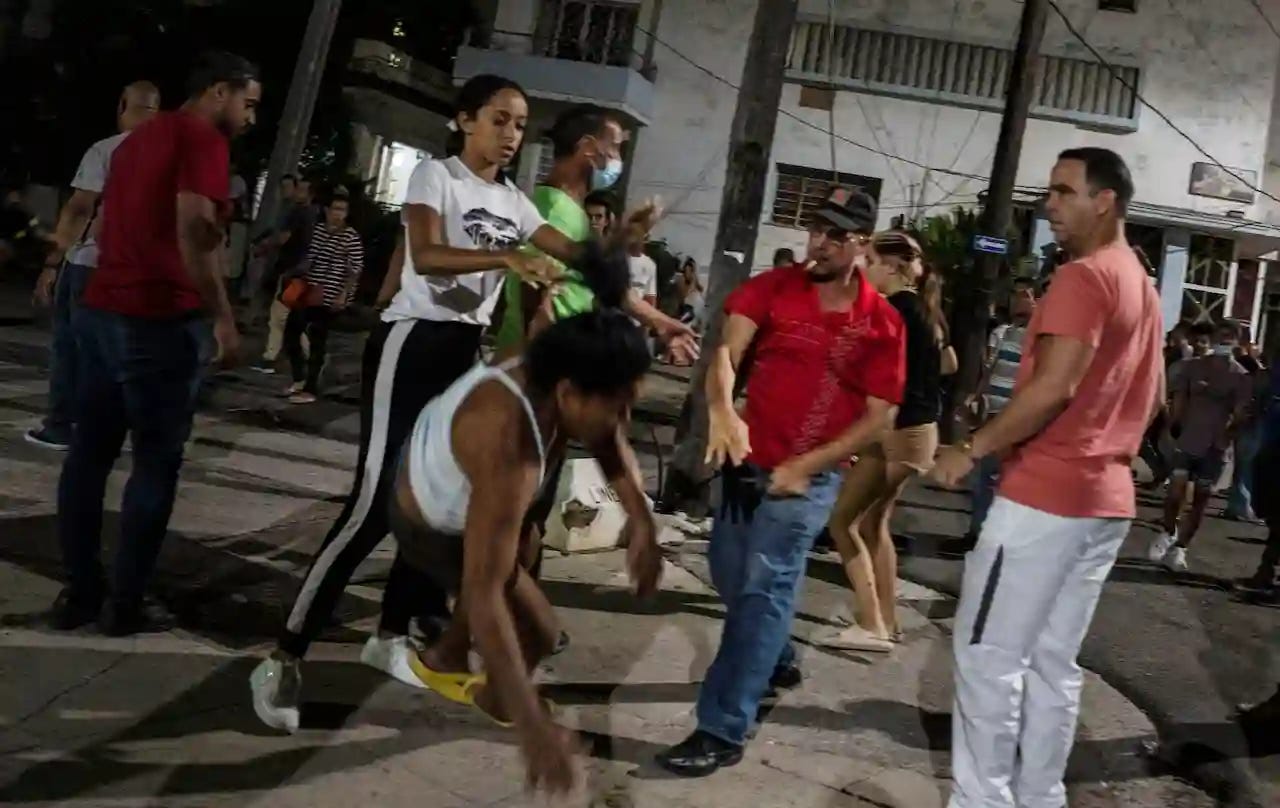
As the country faces repeated blackouts, this September, at least 15 protesters were sentenced to up to nine years in prison for participating in a day of protests in Cuba over power and food shortages. Last month, the United Nations Working Group on Arbitrary Detention concluded that Cuba was the world’s leading country in the number of arbitrary detentions.
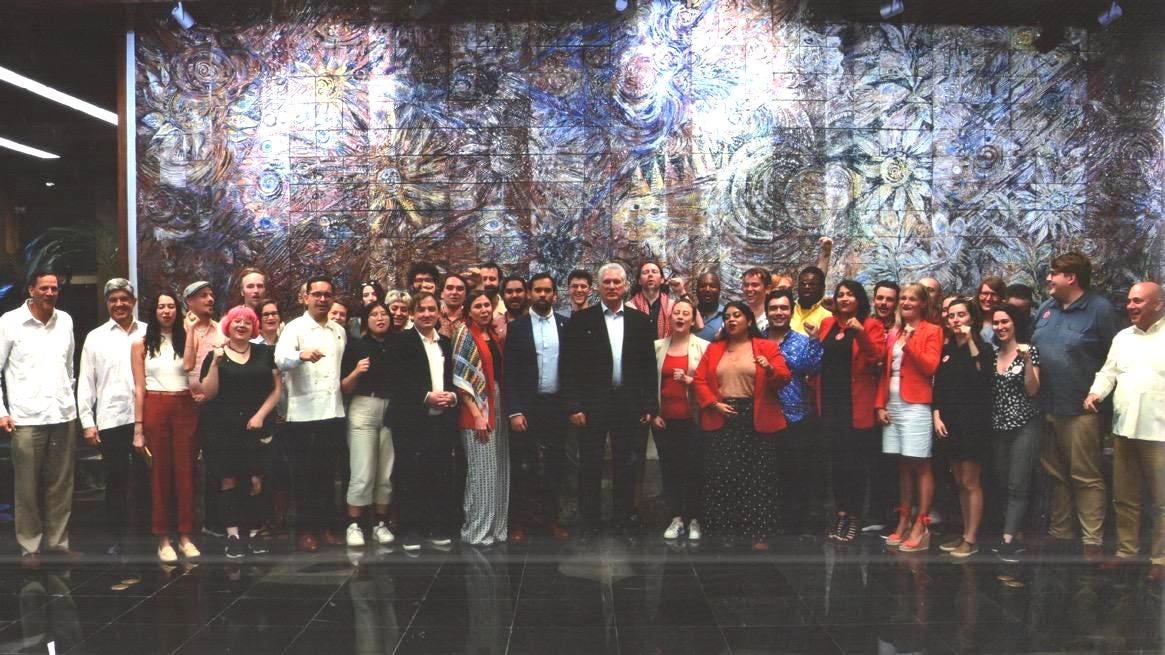
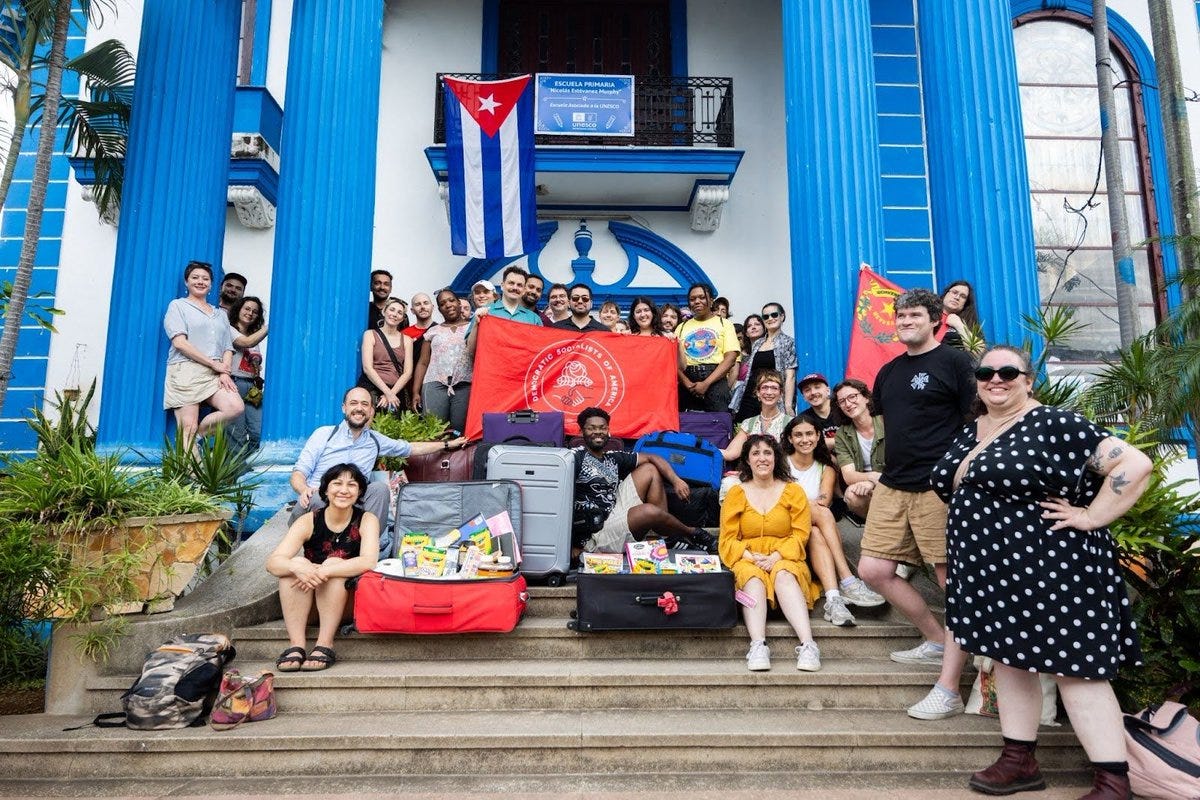
Such a tableau of repression and deprivation might seem like an odd location for dozens of self-identified progressive Americans to wash up, but that is exactly what members of the Democratic Socialists of America (DSA) did this past October, just as they had done in October 2023. On 20 October of this year, the DSA’s official account posted a thread on X (formerly Twitter) where DSA members posed grinning before a few suitcases and boasting of how “we were honored to send a delegation of 40 DSA elected leaders & rank-and-file members from chapters big & small across the country to #Cuba, where they delivered hundreds of pounds of solidarity aid & learned about the achievements & challenges of Cuban socialism.” The thread went on to depict a regime-managed tour of Havana and its environs and boasting, without a hint of irony, how the delegation “met Cuban workers, doctors, teachers and artists who keep the country running despite the growing hardships imposed by the U.S. blockade” before concluding “We return more determined than ever to end the cruel U.S. blockade and stand with the Cuban people as they fight to build a brighter future for their country.” Two days later, in a video also posted on X, the DSA’s National Co-Chair, Megan Romer, said that she had been part of the delegation along with “20 some of my closest comrades” who went to “see the situation on the other side of the blockade for themselves [and] to hear from Cubans about how U.S. policy affects them [and] the way they are defending their sovereignty and their right to live the way they want to live.”
Of course, it goes without saying, on trips that - by the delegation’s own testimonies - were organized by the country’s Communist Party, the DSA didn’t meet or interact with “the Cuban people” at all. But who they did interact with, their behavior while in the country and their published opinions regarding Cuba and its challenges afterwards reveal a lot about an organization that recently saw one of its members, Zohran Mamdani, elected mayor of New York City.
[For my part, despite some reservations I had about him, after his primary victory in June, I urged people to vote for Mamdani given the repellent characters (Andrew Cuomo, Eric Adams) he was running against.]
The first thing that those outside the United States should probably understand is that the DSA is not a “democratic socialist” political current in the way that term is generally understood in Europe and elsewhere. The DSA in its current form is a deeply sectarian entity that has a long record of supporting repressive regimes as long as said regimes spout the correct “anti-imperialist” rhetoric. The DSA refused to endorse Joe Biden in the 2020 presidential election against Donald Trump and, following Vladimir Putin’s genocidal, imperialist invasion of Ukraine, the DSA called, by way of a solution, on the United States “to withdraw from NATO and to end the imperialist expansionism that set the stage for this conflict,” this despite the fact that Putin himself has said plainly that “all of Ukraine is ours.” Before its forays to Cuba, the DSA’s most high profile interaction in Latin America was a widely-mocked bit of revolutionary tourism when DSA members flew to Caracas, Venezuela in June 2021 on a propaganda trip to stuff their faces and raid the mini bar at the Meliá Caracas - only a few minutes away from the government-run torture prison of El Helicoide - while praising the supposed socialist utopia that dictator Nicolás Maduro, the capo di tutti i capi of an octopus-like criminal network, had created there. DSA members lauded a regime that United Nations investigators have found committed crimes against humanity and whose actions, testimony submitted to the International Criminal Court affirmed, included the most horrific kinds of sexual violence. And, to be clear, this wasn’t some rogue operation but a trip sanctioned and supported by the DSA’s National Political Committee.
Last month, fresh from this year’s “solidarity” trip to Havana, DSA members were making common cause with the Cuban dictatorship at its embassy in Washington. DSA member Tabitha Arnold celebrated the “legacy” of Fidel Castro who, among his other accomplishments, imprisoned and tortured gay men in concentration camps, and spoke of how she had been “really moved as a labour organizer…seeing what it looks like for a state to be truly organized around the needs of working people,” which no doubt came as news to those living under a regime where workers do not have the right to strike or bargain collectively, and where independent labor unions are illegal. At the same event, DSA member David Zatyko said he attended to “celebrate the life of Fidel Castro” and “the incredible advancements in healthcare and health services in Cuba” while denouncing “the economic embargo and the blockade.” Zatyko said this at a time when and when Cuban doctors are suggesting that their government may be lying about an alleged chikungunya epidemic on the island, saying that the symptoms of those affected do not correspond to an arbovirus but rather to a respiratory illness similar to COVID-19.
A word about the “embargo” or “blockade,’ as DSA members are wont to call it. The series of coercive economic measures enacted by the United States since 1962 have had absolutely zero positive impact in terms of bringing democracy to the country but have indeed helped increase misery there and provided Cuba’s government with a handy excuse on which to blame the failures of its broken ethos of economic ignorance and idolatrous militarism. Despite the idea that there is no trade between the two nations, though, the United Staes government “regularly authorizes the export of agricultural products, medicine and medical equipment, as well as humanitarian goods, to Cuba” unless there is a determination of of “reasonable likelihood” that the products might be used for torture, re-export or the production of Cuba’s biotechnological industry, a highly subjective definition. In 2024, in fact, U.S. exports to Cuba increased by 16%, with a flow of $585 million to the island that year. Despite claims of poverty that the DSA credulously repeats, Cuba’s military-run Grupo de Administración Empresarial S.A. (GAESA) - a conglomerate which combines business aspirations with merciless repression - currently holds $18 billion in assets, larger than the international reserves of entire nations like Costa Rica, Uruguay and Panama. Global companies like Meliá Hotels International and Iberostar Group operate widely in Cuba, with the latter operating, among other properties, the Torre K hotel, which the Cuban government saw fit to invest over $200 million in as the country’s electricity grid collapsed. Last year, Cuba’s ossifying, reactionary dictatorship, unable to provide its people with food or electricity or democracy, took the time to create a new surveillance brigade of “inspectors of social communication” to monitor citizens’ use of social media. As the Cuban director Carlos Lechuga poignantly wrote in the wake of the 2021 protests, “nobody in the streets shouted ‘Down with the blockade.’ They shouted ‘Down with Díaz-Canel.’”
The most voluminous account of the DSA’s 2023 trip to Cuba comes from Danny Valdes, the co-chair of DSA Cuba Solidarity and currently a prospective candidate for Assembly District 75 on Manhattan’s West Side. A Cuban-American Miami native whose grandfather, he writes, was “jailed for 6 years by the nascent revolutionary government,” in his account Valdes makes it clear that the trip essentially alternated between delegation members gorging themselves on plentiful food in hotels and restaurants (which, to his credit, he admits made him feel “uncomfortable” in a place where hunger has reduced people to hunting for birds and iguanas and even their neighbors’ pets) and then being goose-stepped to a series of Potemkin villages by their government minders. The first official they hear from is Juan Carlos Marsan Aguilera, the Deputy Head of International Relations of the Cuban Communist Party (and now Cuba’s ambassador to India) and then the delegation is suitably starry-eyed when taken to visit Centro Nacional de Educación Sexual (CENESEX), a government entity that is ostensibly a teaching, research, and assistance institution in the area of sexuality and portrays itself as advocating in behalf of the rights of LGBTQ people, but which was founded and continues to be run as a personal fiefdom by Mariela Castro, the daughter of Raúl Castro and a highly privileged hetrosexual CIS woman utterly intolerant of any suggestion she not be the sole face of the island’s marginalized sexual minorities. Many LGBTQ people I know in Cuba, a country I’ve visited more than a dozen times, view CENESEX as a classic example of the most cynical kind of pink-washing, an entity of regime control as opposed to personal liberation, and in May 2019, when hundreds of LGBTQ activists attempted a conga parade through La Habana Vieja, an unauthorized event that was separate from the regime’s “official” LGBTQ events affiliated with the CENESEX, the march was immediately set upon by security forces, its leaders beaten and arrested. The irony of all of this appears to be lost on the DSA delegation, however, with Valdes writing that CENESEX “underlines that the Cuban Revolution saw itself as a cultural revolution as much as a political and economic one” and of “a poignant moment” where Castro asks the delegation “to hold a minute of silence for the people of Gaza.”
Though Valdes writes that “Cuba spends 27% of the state budget, some 11% of it’s GDP, on public health,” in fact, as the outlet 14 y Medio reported, according to Cuban government figures, health and education in Cuba combined receive only 3.3% of the Cuban state budget, while the budget dedicated to business services, real estate and rentals (an umbrella definition which includes tourism) receives 33%. Valdes goes on to praise what he calls Cuba’s “medical internationalism” - that is, the government’s practice of sending medical doctors abroad - but nowhere mentions what those sent abroad themselves have to endure. In a 2020 report, Human Rights Watch cited how Cuba’s dictatorship “imposes draconian rules on doctors deployed in medical missions globally that violate... the right to privacy, freedom of expression and association, liberty, and movement.” That same year, the Miami Herald reported how the Cuban state had pocketed $70 million from Algeria’s government in exchange for the 900 doctors it sent to the North African country, but had not bothered to pay any of the doctors their salaries for months. In 2018, Cuban doctors working in Brazil compared their lot to “being a slave” in an article in the New York Times. The same year, another doctor told Reuters the Cuban government treated them “like property.” In Venezuela, the site of the DSA’s first much-ridiculed “solidarity mission,” the Maduro dictatorship has used Cuban doctors as instruments of social and political control, with the doctors themselves telling the Times in 2019 how they were “ordered to go door-to-door in impoverished neighborhoods, offering medicine and warning residents that they would be cut off from medical services if they did not vote for Mr. Maduro or his candidates.”
Sitting in the Capitolio - where the legislature of a democratic Cuba once met before Fulgencio Batista’s 1952 coup and then more then six decades of Communist totalitarianism - the delegates listened to Homero Acosta Álvarez, the secretary of the so-called Asamblea Nacional del Poder Popular (in reality no more than a rubber stamp for the country’s Communist elite) before Valdes concludes, as a foreigner who doesn’t have to live under such a system, “I don’t find it useful to judge how democratic the Cuban government is.” The group is eventually spirited away to sit with Miguel Díaz-Canel, the valet and public face of the rancid oligarchy that controls the country, who meets with them for “just over two hours” and which puffs up the DSA enormously about their “big accomplishment” in meeting one of the island’s main jailers as “it was a sign that the Cuban government took our organization seriously and saw us as potential partners in the work of ending the US blockade.” By the time Valdes gets around to visiting a kind of “model village” ostensibly created by Cuba’s Comités de Defensa de la Revolución (CDR) - regime entities that Human Rights Watch has correctly characterized as “neighborhood surveillance groups [who] monitor and report on Cubans at home, at work and at school” - he seems at pains not to be too critical of the entities or the government that created them, even though, as he admits, “it was a CDR that investigated my grandfather and arrested him for ‘counter revolutionary activity.’”
Valdes was not the only member of the 2023 DSA delegation to have some qualms about the regime that was hosting the group.
Writing about her own participation in the 2023 trip, Maria Franzblau, the co-chair of the Miami DSA, rarely among DSA members (at least publicly), noted the regime’s “crisis of political legitimacy” and that “just because these crises can be attributed to external forces doesn’t mean that every decision of the state has been correct or that every mistake has been inevitable.” She then went on to note
Because we were hosted by the Communist Party, the vast majority of our itinerary involved us meeting state or party officials and representatives from the party’s mass organizations. These meetings mostly consisted of us receiving lectures followed by a Q&A period, instead of any even exchange of ideas, tactics, and advice. On several occasions comrades asked our Cuban counterparts for advice on our own organizing, and consistently we were met with non-answers. At no point in our itinerary did we meet with independent, critical, or alternative leftist voices, and criticisms of the country’s bureaucratic political structures were almost entirely absent.
Declining the tête-à-tête and photo op with Díaz-Canel, Franzblau then writes that she met with several individuals and entities that have voiced (relatively mild) criticism of the Cuban government in the past, but no one who truly or directly threatened the regime and its ruling mythos.
But the voices of Valdes and Franzblau, restrained as they are in their criticism of some aspects of Cuba’s dictatorship, are clearly minorities in a DSA that is all in with the Cuban regime’s policy of brutal security coercion and social control.
In an April 2024 posting on the website Red Star Caucus - where one can avail oneself of riveting prose such as “Lenin’s (and Red Star’s) vanguard arises from organic unity of struggle”- the DSA’s Christina Warren, Ronald Raju Joseph and Andrew Thompson co-authored an essay in which they lash out at Franzblau and the New York attorney Renée Paradis (who was also part of the DSA’s 2023 delegation) for “declining to meet with the president of Cuba, who held a frank conversation with the delegates who did attend for more than two hours” which they characterized as “disrespectful behavior toward our hosts.” They also went as far as to attack any suggestion of “regime reform” as being “a posture that has not only been consistently voted down across multiple national conventions but also actively contradicts and harms the anti-imperialist work our organization is engaged in.” To Sidney Carlson White, a member of something called the “Marxist Unity Group” within the DSA, the purpose of the trip was not to show solidarity with Cuba’s people at all, but rather to “collaborate with our institutional allies that form the Cuban state” and that “engaging with political prisoners is not possible (or, in my view, even necessary).”
The DSA’s silly revolutionary cosplay of privileged, ill-informed Americans striking radical poses abroad before scurrying back home would be the object of good fun, perhaps, were it not done in the service of laundering the image of a dictatorship that is destroying the lives of Cubans as we speak, a project that the DSA is clearly fully on board with and for which they should be held accountable for. The DSA was engaged in their parlour-room antics at moments of real misery for the victims of the Cuban regime and as the messages from those imprisoned in its gulag made for ever-more heart-rending reading. The past August, writing to his young daughter, Maykel “Osorbo” Castillo advised her “my girl, I love you, be strong like your dad, everything will be okay.” This past May, Cuban journalist and author José Gabriel Barrenechea - who has been detained since November 2024 for daring to participate in protests over Cuba’s ongoing energy crisis under the catch-all charge of “public disorder” - was denied a request to see his 84 year-old mother before she died of cancer. In the wake of his mother’s death, Barrenechea penned an open letter in which he wrote
Knowing the country in which it was my turn to live, I committed the grave crime of joining my neighbors in the civic demand for electricity…because it distressed me to see her every night in the darkness, unable to visit anyone, without her television and her novelas, locked in her sadness…I couldn’t say goodbye to her, I couldn’t ask her forgiveness and receive her blessing. I couldn’t tell her how, after so many years of denying the truth, I have finally understood what is truly essential in the human world: Its foundation is those who, amidst suffering and joy, give birth to us, our mothers. She, I know, he forgives me and continues to watch over me. From that better place where I, too, try to deserve to go, someday.
What is extraordinary about the DSA is both their complete lack of curiosity about Cuba and their cultural ignorance of it. Decades of Cuban literature depicting the regime’s sadism and repression and the price those living under it have paid - from Heberto Padilla’s En mi jardín pastan los héroes to Reinaldo Arenas’ Antes que anochezca to Pedro Juan Gutiérrez’s Trilogía sucia de La Habana to Zoé Valdés’s La nada cotidiana to Wendy Guerra’s Todos se van - holds absolutely no interest for them. Neither do personal or journalistic chronicles of the Cuban system’s destructive malevolence such as Carlos Franqui’s Retrato de familia con Fidel, Jorge Edwards’ Persona non grata or Alma Guillermoprieto’s Dancing with Cuba: A Memoir of the Revolution. The significance of the regime’s fanatical aversion to any independent expression of Afro-Cuban culture, for example - from its absurd persecution of the rapper Nando OBDC to the sneering racism of aging regime princesa Aleida Guevara March (daughter of Che Guevara) that the island’s protesters have “a very low level of culture” to its fretting about the subversive musical genre of reparto - ring absolutely no alarm bells for them. Why bother to really engage intellectually and politically with what the “revolution” has actually wrought when you can cruise around in old cars and repeat tired slogans whose sell-by date passed decades ago? Unlike the DSA, after a visit to the island this past July, the left-wing Chilean writer and political analyst Patricio Herman Fernández wrote in El País that “no one believes in the Revolution anymore. The Diaz-Canel government does not inspire either affection or respect among Cubans. Almost nothing is produced in the country...[Cubans] are unable to imagine the next step in this story, how much worse it can get.”
For his part, Zohran Mamdani seems to have evolved on the issue of Cuba (and Venezuela) even if his party has not, telling journalist Jorge Ramos and his daughter Paola Ramos in September that
I want to be clear on where I stand. I believe both [Venezuela’s] Nicolas Maduro and Miguel Diaz-Canel are dictators. Their administrations have stifled free and fair elections, jailed political opponents, and suppressed the free and fair press.
Mamdani went on to blame the “blockade” for having “worsened these conditions,” but the change is notable. Whether this is a true change of heart or merely the politically expedient words of a politician looking to broaden his brand remains to be seem.
In the final analysis, though, how one quantifies what the Castros, Diaz-Canel and their apparatchiks brought to Cuba is measured in lives destroyed, people sent desperately to sea or through the jungles of South America to try and find a new beginning, of the immense human potential of Cuba’s irrepressible, inventive and joyful people that has been erased. This all been done to feed the vindictive and jealous possessiveness of a failed system that once famously declared dentro de la Revolución todo, contra la Revolución nada (Within the Revolution, everything; against the Revolution, nothing).
But the DSA as a whole continues to glory in the brutalities of the Cuban government’s state terrorism, and the organization and party appears to have not progressed at all since its disastrous trip to Venezuela four years ago. It remains an immature, campist entity whose members see their loyalty as being to bemedaled generals and reactionary bureaucrats rather than to an actual international working class. If the DSA wants to be threated like an organization on the side of the disenfranchised in the United States and beyond, they need to start acting like one, not as the public relations army of any tyranny that winks in their direction. Despite the self-righteous and self-important tone of their public statements, the DSA still lacks basic compassion, empathy, and humility when it comes to engaging with people suffering on the downside of regimes like those in Havana and Caracas.
As protests continue to bubble up around the country and Cubans grind through another episode of mass blackouts, one’s heart wrenches and my mind turns to the Cubans I have met all over the world who have been forced out of their country rather than living under the system the DSA is so eager to defend. Last month, before he passed away in exile in Mexico, where he had served as a teacher and mentor at the Universidad Veracruzana for many years, the renowned Cuban playwright Salvador Lemis wrote the following
I will return to Cuba when all those old men who made my life a living hell are dead...Someday, not too far off, Cuba will once again be a country of parties and trains crossing fields sown with delicious things...I want a Cuba where there are hutias, parties, buses, tricycles, cafes, free beaches, hotels for Cuban families, balloons, candy, supermarkets, magazines, identity cards that aren’t crosses, many political parties of many colours and ideas, toy stores, bakeries, hat and umbrella shops, free and cheap passports...Medicine and oxygen; fashion shows; more universities without dogmas; that boarding schools be prohibited and trees planted; that the old Che Guevara slogans not be repeated; that there be chocolate and yogurt… Without Pavlovian training… That is, without those thugs, janissaries and mummies.
Long live a free and democratic Cuba.