
Leon Botstein Must Go
The Bard College President's Extensive Relationship with the Sexual Predator Jeffrey Epstein - And More - Makes His Position Untenable

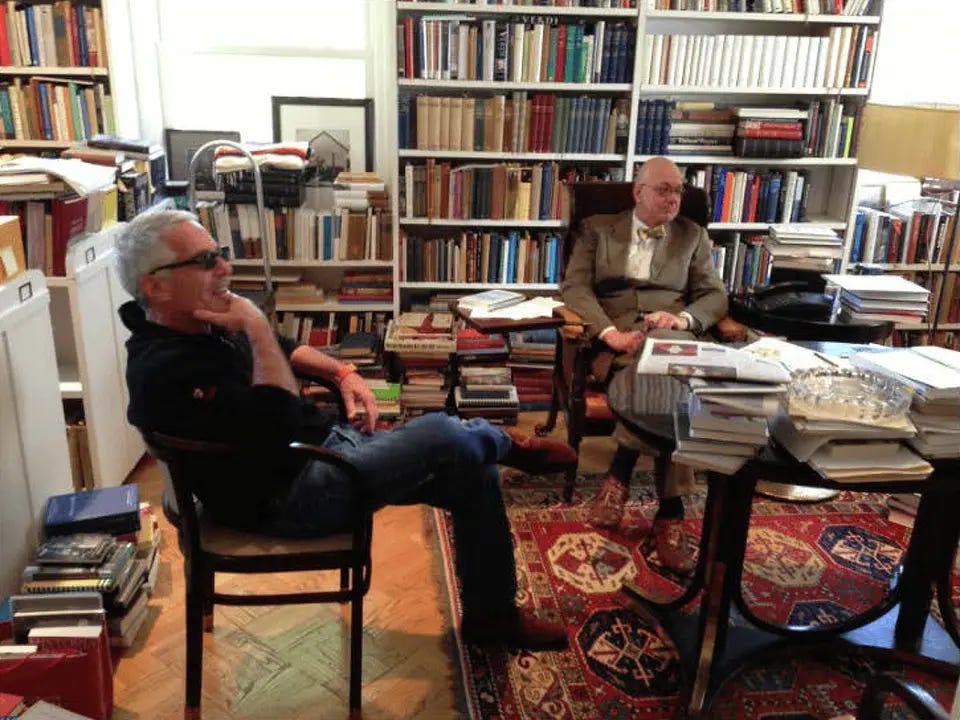
When I arrived at Bard College as a freshman in the late summer of 1992, I remember being greeted by a preponderance of flowers along the rural roads leading there. I had driven up from Pennsylvania in a 1976 Plymouth Valiant and soon found myself meeting people from all over the country and all over the world and strolling through Blithewood Gardens as it looked down onto the Hudson and played host to sun setting fiery behind the Catskill Mountains across the river. Coming from a relatively hardscrabble, blue-collar upbringing and having somehow gained acceptance at the college - my high-school record was marked by excellence at English and History and near-incomprehension in Math and Science - the small, progressive liberal arts college made an interesting first impression, seeming as much somehow plugged into the intellectual milieu of New York City some 90 miles to the south as it was your standard rural American academic cantonment. That autumn, the New York Times Magazine even ran a profile of the school, or more specifically, of its leader, Leon Botstein, and titled the highly laudatory piece “The Most Happy College President.”
Leon Botstein had been president of Bard - a position he still holds - for 17 years at that point, having assumed the job when he was only 29 years old. During his decades at the helm of the college, he would go on to do a great deal to elevate its reputation, including, but not limited to, founding the Bard Music Festival (an annual classical music festival held on campus every August), overseeing the construction and opening of the Frank Gehry-designed Richard B. Fisher Center for the Performing Arts and helping oversee the launch and continuation of the Levy Economics Institute, the Bard High School Early College series of early college schools and the Bard Prison Initiative, which provides college education to incarcerated persons.
An impressive and enlightened record, one might fairly conclude, especially given a current political and academic environment in which institutes of higher learning that show even the faintest hint of progressivism (or, more accurately, do not surrender to paleofascist extremism) are directly targeted by the current regime in charge in Washington, D.C.
There was, however, always another side to Botstein’s long tenure as the capo di tutti i capi of the college, and discussion about the nature of that corollary to the school’s many accomplishments appear to have been loosed by the latest revelations about Botstein’s relationship with the American financier and sex offender Jeffrey Epstein. What seemed like a commitment to personal freedom at the time - and which greatly appealed to a lot of students who arrived at the college awash in the ethos and sometimes-reflexive libertinism-verging-on nihilism of writers and musicians like William S. Burroughs, Lou Reed, Hunter S. Thompson, Louis-Ferdinand Céline and others - in retrospect and given what has come to light in years since may have been something else altogether.
When I was there in the early-mid 1990s, there was always something of a dark undercurrent to Bard’s veneration of individual liberty for the young students under its charge. The fact that one was able to study at close quarters with such luminaries as the poet John Ashbery, the novelist Chinua Achebe, the translator William Weaver and others existed in an atmosphere in which transgressing social and sexual boundaries, predatory behavior by faculty, staff and students and fairly widespread alcohol abuse and hard drug use (I was certainly no exception to the latter category) made one feel that a murky flow was chugging along just below the surface. During my time at Bard, there was a near-fatal heroin overdose and a catastrophic drunken driving accident, which both the driver and the passenger miraculously survived. After the former, I remember Botstein making an appearance at a campus meeting held at what was then the dining hall to decry the fact that overindulgence meant that students sought to “break the machine” of their bodies. I remember him speaking briefly in a winter coat, as if he had somewhere else to hurry off to and was just stopping in.
Since my graduation from the college three decades ago, along with this rather hedonistic environment, there has been also been a steady drumbeat of violence, much of it directed against women, much of it directed against female students or alumni, connected to Bard, and while the administration cannot be blamed for all or even most of it, their response to these incidents is perhaps worth noting given recent revelations.
Between 1995 and 1997, there were a series of ghastly rapes on the fringes of and further afield in the rural areas near campus, especially in a conservation area known as Tivoli Bays, including of a 34 year-old mother and her 7 year-old daughter. A Bard student who was assaulted and raped on Annandale Road, just off campus, in 1995 in an assault that may or may not have been linked to the Tiovli Bays attacks, told me when I spoke to her recently that, when her parents met with Botstein in the wake of the attack, “he communicated that he did not see himself as personally responsible for student safety.”
Shortly before he was to graduate, Kenneth Park - who I knew slightly as a soft-spoken, coffee-drinking philosophy student working his way through the complex oeuvres of Julia Kristeva and George Bataille - imprisoned his then-girlfriend in his dorm room for several days before she managed to escape. Sent home from the school, two years later, he would murder his father and two sisters at their shared home in Quincy, Massachusetts. In 1998, at a party at a private home only a mile from Bard, a student named Anna Jones was stabbed to death by her boyfriend, a former student named Tor Loney. Loney subsequently pleaded not guilty by reason of insanity. He was briefly sent to a psychiatric center and then released. In February 2011, a Bard student named Kate Blake - the daughter of a friend of mine - was stabbed by Henry Pfeffer, another Bard student and her former boyfriend, as she lay in a coma in a hospital bed after being hit by a truck five months earlier. She survived the attack but died from causes related to her initial injuries two months later. As with Tor Loney, Pfeffer was found not guilty due to mental illness, was institutionalized for a time and then released.
Perhaps most troubling in terms of the Bard administration’s involvement, in September 2016, former Bard student Render Stetson-Shanahan stabbed another former Bard student, Carolyn Bush, to death in the Queens apartment they both shared, and was subsequently convicted of second-degree manslaughter. [Stetson-Shanahan is the son of former New Yorker cartoonist Danny Shanahan, who was arrested in 2020 on a charge of possession of child pornography but died before the case could be resolved. His mother, Janet Stetson, works as the Director of Graduate Admissions at Bard.]
As chronicled in the author Sarah Gerard’s Carrie Carolyn Coco: My Friend, Her Murder, and an Obsession with the Unthinkable, Leon Botstein subsequently “wrote two letters to the courts in support of [Stetson-Shanahan], calling him ‘a very appealing, well-mannered, well-groomed, and thoughtful person, with a very distinctive artistic talent’... Alongside Botstein, seven other Bard administrators and professors wrote letters to the court in support of Stetson-Shanahan, routinely describing their shock that someone as gentle and peaceful as he could commit such a crime.” Stetson-Shanahan is scheduled to be released from custody this coming May.
Certainly, Botstein cannot be blamed for the actions of unrelated individuals in moments of criminality or psychosis. But, nevertheless, some of his own writing may give some insight on how he viewed his role and the role of the college in the lives of the students that passed through its doors, and of female students, in particular.
In a 1999 essay for the New York Times, “Let Teen-Agers Try Adulthood,” - whose title lands rather differently today given the revelations about Botstein’s relationship with Epstein - Botstein writes that “adults” have “used high school to isolate the pubescent and hormonally active adolescent away from both the picture-book idealized innocence of childhood and the more accountable world of adulthood.” He then continues:
Young people mature substantially earlier in the late 20th century than they did when the high school was invented. For example, the age of first menstruation has dropped at least two years since the beginning of this century, and not surprisingly, the onset of sexual activity has dropped in proportion. An institution intended for children in transition now holds young adults back well beyond the developmental point for which high school was originally designed.
Most people reading this, I don’t think it is a stretch to say, would find Botstein’s fixating on teenage sexuality and girls’ menstruation cycles pretty weird, if not downright creepy, but these are the publicly stated beliefs of the man who would later invite Jeffrey Epstein to the campus of the college he was president of.
Which brings us to the nature of Botstein’s relationship with Jeffrey Epstein, a relationship that, based on correspondence in recently-released Department of Justice files, spanned at least six years.
As recounted in the Miami Herald’s masterful “Perversion of Justice” series, in March 2005, a 14-year-old girl and her parents reported Epstein had molested her after she had been taken to his Palm Beach mansion by a female classmate to give Epstein a massage in exchange for money. Though federal prosecutors eventually identified 36 underage victims, the United States Attorney for the Southern District of Florida at the time, Alexander Acosta [who later served as Secretary of Labor under the first Donald Trump administration], repeatedly met in private with Epstein’s defense team, which included Harvard professor Alan Dershowitz, former U.S. Attorney Guy Lewis, and Kenneth Starr, the former Whitewater special prosecutor who investigated Bill Clinton’s sexual liaisons with Monica Lewinsky. The group hammered out an outlandish sweetheart deal that allowed Epstein to plead guilty to a single state charge of solicitation of prostitution and one count of solicitation of prostitution with a minor under the age of 18. Epstein served only 13 months in the county jail, and the deal - called a non-prosecution agreement - essentially shut down an ongoing FBI probe into whether there were more victims and other powerful people who took part in Epstein’s sex crimes. A 2007 article in New York Magazine - not exactly an unknown publication to the denizens of Bard - described the feelings of the girls that Epstein abused as ranging “from disgust to fear. Epstein was the hairy troll under the bridge they had to pass over to get quick money.”
At the time Botstein began his correspondence with Epstein and the latter’s subsequent visits to Bard, Epstein was classified by the State of New York Board of Examiners of Sex Offenders, which had reviewed the history of abuse allegations against him, as a Level 3 sex offender, the highest possible risk level. When the first revelations of Botstein’s links with Epstein were published in the Wall Street Journal in April 2023, Botstein blandly blew off Epstein’s history of predation by saying “We looked him up, and he was a convicted felon for a sex crime. We believe in rehabilitation.” While Botstein admitted at the time that he had received $150,000 from Epstein’s foundation, Gratitude America, in 2016, he told the New York Times that he had donated the entire fee to Bard.
In a January 2013 email to Epstein from an undisclosed assistant - subject heading “Botstein tomorrow” - the writer informs Epstein “I have confirmed with Lynn Meloccaro you will go tomorrow to Botstein’s dress rehearsal as planned at Carnegie Hall. [This part is redacted] names have been added to the list. All of you must take ID with you.” Then, added almost as an afterthought: “What time would you like the girls at the house tomorrow to go with you (starts at 11am)?” In a May 2013 email to Epstein, Botstein recommends “our immigration lawyers” to a man who had been trafficking children for the purpose of abusing them. Epstein then forwards the message to immigration attorney Mehmet Arda Beskardes - whose ability to practice law was later suspended.
For the next several months, email correspondence continued, usually by the staff of the two men, about Epstein’s planned May 2013 visit to Bard. In an April 2013 email from Lesley Groff to Epstein with the subject header “Leon Botstein” - Groff writes “May 3rd is perfect for Leon Botstein for a visit from you to Bard.”
Groff was among four women close to Epstein who were named as unindicted co-conspirators in his 2008 non-prosecution agreement. In a 2019 lawsuit, Jennifer Araoz - who says she was recruited outside of her New York high school by one of Epstein’s lackeys when she was 14 and raped by him when she was 15 - charged that Groff played a key role in facilitating the sexual abuse. Araoz eventually dropped the case when she accepted payment from a victims’ compensation fund that stipulates applicants cannot sue Epstein’s employees.
In an email thread from July 2013, a redacted Epstein confidante writes to Catherine Susser Luiggi (then Botstein’s Executive Assistant and currently Associate Director of Alumni/ae Affairs at Bard) “I wanted to let you know Jeffrey has heli wheels up at 10:30am on Sunday July 28th to come up to Bard…as soon as I know exact landing time” before querying “do you know where Jeffrey is to go once he lands on Sunday?? Leon’s house at Faculty Circle Road?” to which Susser Luiggi replies in the affirmative before the subject moves on to what the guests will eat and Susser Luigi noting “there will be two cars with drivers available for them while they are on campus so that they are free to move around as they wish,” a chilling thought considering they are talking about a predatory rapist.
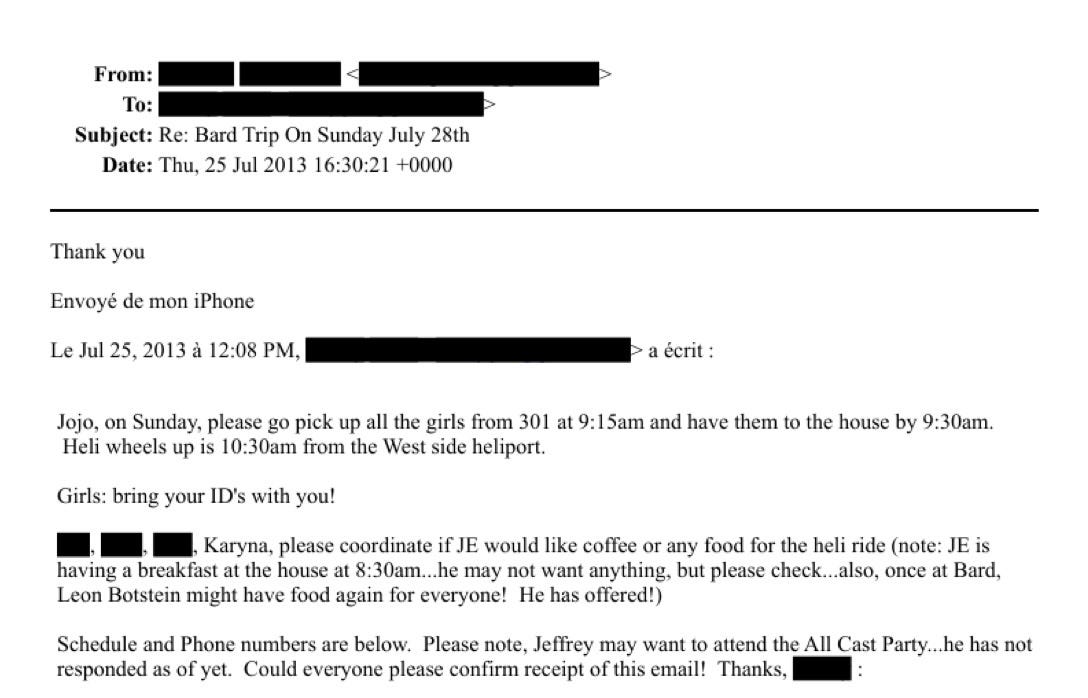
In a 25 July 2013 exchange between two redacted Epstein intimates, one writes “Jojo, on Sunday, please go pick up all the girls from 301 at 9:15am and have them to the house by 9:30am. Heli wheels up is 10:30am from the West side heliport. Girls: bring your ID’s with you!” before noting that “once at Bard, Leon Botstein might have food again for everyone! He has offered!)”
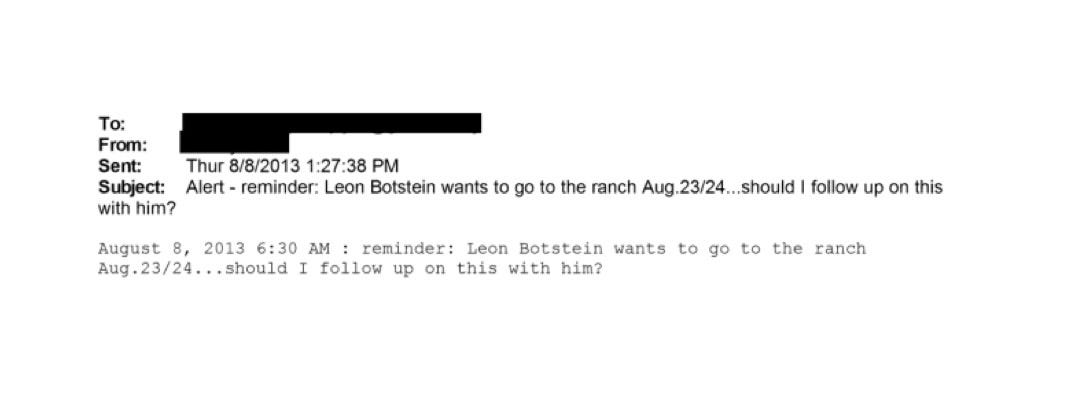
After Epstein’s July visit to Bard, in an August 2013 exchange, two redacted correspondents write that “Leon Botstein wants to go to the ranch Aug.23/24...should I follow up on this with him?” The “ranch” in question was Epstein’s home, Zorro Ranch, in New Mexico, where accusers said Epstein is known to have raped and abused girls. When asked about the potential ranch visit for a recent article in the upstate New York daily the Times Union, Botstein’s “spokesman,” David Wade, tut-tutted the idea saying that Botstein “never been to any ranch in New Mexico.” If he hadn’t, it didn’t appear to be for lack of trying.
Over the next few years, the emails between Botstein and Epstein appear to grow more intimate and rather dark and strange. On 25 March 2015, Botstein wrote to Epstein “I have the sense of fighting my worst enemies in a shadow way, not openly, and I surely have them,” and in a later exchange in the same correspondence thanked Epstein “for the candor and the friendship,” before going on to brag about the “medals and awards” he received for “ my work in music.” Then, bringing up Vladimir Nabokov - author of the novel Lolita, in which a predator grooms and victimizes a 12 year-old girl - Botstein writes “again think of Nabokov, whose favorite Russian poets were often obscure figures derided by all the other critics. He stood alone.” He then goes on to tell Epstein “I greatly cherish this new friendship and I have real admiration for how you go about doing things.” One wonders exactly what exactly about the way of “doing things” the pedophile had that held allure for Botstein.
In a December 2018 exchange about a Botstein visit to Epstein’s island aboard the plane of the American private equity investor Leon Black, Annemarie Bemis (then and still today serving as Botstein’s Executive Assistant) writes
Thanks for the information about the plane for Thursday’s travel to St. Thomas. Per your request, I am sending along a pdf copy of Leon’s passport. Please let me know if you have trouble opening the attachment. I still have to ask Leon about the return trip on Saturday. Would it be possible for you to give me some more information about the Cape Air flight(s) that you mentioned yesterday? I want to give Leon all of his options for travel on Saturday. I believe the only direct flights are in the afternoon on either Delta, American or United.
The unnamed correspondent writes back “Leon will need to leave Jeffrey’s island about 2 hours 15 minutes prior to his flight departure.”
The island in question was Little Saint James, the private island in the United States Virgin Islands which Epstein used as one of the bases for his underage sex trafficking operation. In 2019, a former air traffic controller who worked at Epstein’s private air stip on the island told Vanity Fair:
On multiple occasions I saw Epstein exit his helicopter, stand on the tarmac in full view of my tower, and board his private jet with children—female children. One incident in particular really stands out in my mind, because the girls were just so young. They couldn’t have been over 16. Epstein looked very angry and hurled his jacket at one of them.
In the words of a recent Bloomberg headline, Epstein served Black for years as “a fixer for [the] billionaire’s deepest secrets,” and to whom Black paid at least $158 million, ostensibly for advice on estate and tax planning. Ron Wyden, the chief Democratic on the Senate Finance Committee, has called for the Internal Revenue Service to probe Black’s transactions with Epstein.
On 10 February, in an email sent from the email address of the Bard College Office of Alumni/ae Affairs and addressed to “the Bard College Community,” Botstein wrote that his “interactions with Epstein were always and only for the sole purpose of soliciting donations for the College. Mr. Epstein was not my friend; he was a prospective donor.” He goes on to note that “contact between Bard College and Mr. Epstein began with an unsolicited gift of $75,000 from him to Bard High School Early College (BHSEC) in 2011 that he gave at the request of a BHSEC parent” and that he (Botstein) then “pursued the possibility of further philanthropic contributions. Mr. Epstein gave a second gift in 2012 to Bard High School Early College, including the donation of computers.” He concludes that “Epstein was a skilled manipulator, prodigious networker, and serial exaggerator, and it appears he used the association with Bard and other institutions to burnish his image, although he never displayed generosity to the College commensurate with his claims of wealth… I am deeply sorry to have involved myself and the College with him in any way.”
Since the latest revelations about Botstein’s connections with Epstein have surfaced, on Bard-related Facebook groups, there has been a flood of testimony from alumnae about a culture of unwanted kissing, groping and comes-ons by male staff members of Bard toward their female students.
“His involvement with Epstein is acting as a catalyst for decades of experiences of assault, violence, inappropriate interactions for people saying 'Oh, fuck it, wasn’t just me,’” says Abigail Morgan who, like me, graduated from the school in 1996 and now works as an acupuncturist and reproductive health specialist in California.
By all accounts, this behavior - and the college’s unsatisfactory response to it - is by no means a thing of the past.
In a 2020 lawsuit against the college, a Bard percussion teacher was accused of grooming and assaulting a student and the college itself was accused of having “knowingly employed a sexual predator as an instructor in its music program and allowed him to prey on students” Bard is also currently being sued under New York’s Adult Survivors Act, which allowed alleged victims of sexual offenses for which the statute of limitations had lapsed to file civil suits for a one-year period from November 2022 until November 2023. In the complaint, the plaintiff charges the college engaged in “negligent, willful, or intentional failures…to protect Plaintiff…from being sexually assaulted on its campus, and further failing to act and respond to [her] report regarding the aforementioned assault which was submitted to Bard College’s Office of Safety and Security.” The circumstances of the disbanding of the college’s lacrosse team have also been shrouded in mystery and controversy.
Perhaps no one should be president of anything for 50 years. Maybe there is an inevitable, sclerotic authoritarianism and denial that seeps into any such long reign [and Botstein’s rule of Bard has been nothing if not a reign]. Botstein’s professed logic for his repeated interactions with Jeffrey Epstein - that he was just trying to get his hands on his money for the good of the college - in no way ameliorates the repulsiveness of the situation and indeed makes it worse. What was the acceptable number of girls Epstein could have abused per dollar amount of any contribution he could have made to Bard? One of the most detestable implicit characterizations of Epstein’s victims by the fetid groves of academe in which Epstein swam - and in which people like former Harvard president Larry Summers, linguist and war crimes denier Noam Chomsky and the physicist Lawrence Krauss willingly accompanied him - was that the girls he attacked were viewed to some degree as throwaway people whose suffering need not inconvenience the great men and their big ideas, marching bravely into the future. Taken with the very real concerns about Bard’s response towards violence against women over the years, Botstein’s interactions with Epstein make his continued presence as the college’s president intolerable.
“It begins with Leon’s behaviour and dishonesty and flows through the administration impacting the faculty, staff and ultimately the student body,” a current Bard College senior I recently spoke to said to me. “Because of his complicit behavior, he gives people hope that they can engage in abuse and get away with it. He represents this misogynistic and abusive culture whether he engaged directly in the behavior or not.”
I’m not sure when exactly what was good for Bard College and what was good for Leon Botstein became so inextricably tied as to become indistinguishable, but that has clearly been the case for some time. If the college hopes to ever live up to the values it professes - and, indeed, which Botstein himself long professed - the only way forward is for him to remove himself from its midst, the sooner the better.