
Ecuador Reporting Trip - A Request for Support

Good afternoon, mi gente, and I hope that this message finds you well and looking forward to tomorrow, Friday, my favourite day. The day when, hopefully, work is done and repast beckons, a day that means we have survived another week and a day, to paraphrase J. P. Donleavy, where we have the possibility of all things to be born like uncovered stars.
I wanted to reach out to everyone who has been kind enough to subscribe to Notes from the World to let them know of an upcoming project I am working on that I hope you might think is worthy of your support.
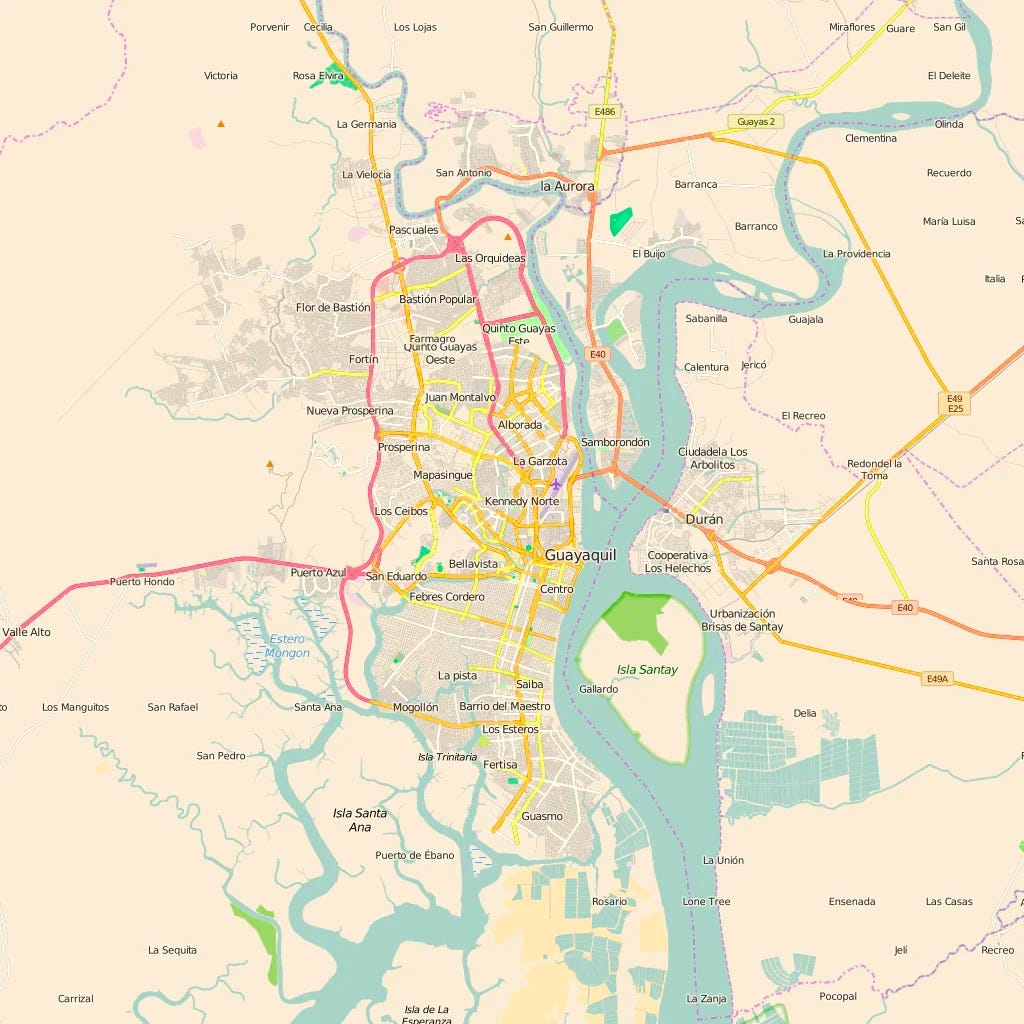
For the last several years, the city of Guayaquil, is the largest city in Ecuador and the nation’s economic capital and main port, has been riven by criminal violence unlike anything the country has ever seen before seen. Local Ecuadorian criminal groups such as Los Choneros and Los Tiguerones have vied for control of the massive Pacific enclave even as they maintained links with large international criminal organizations such as Mexico’s Cártel de Jalisco Nueva Generación (CJNG) and dissident elements of Colombia’s Fuerzas Armadas Revolucionarias de Colombia (FARC). The response of Ecuador’s government, led by President Daniel Noboa and in office since 2023, has been merciless, with a recent report by Amnesty International writing of how “Ecuadorian authorities have opted for the militarization of public security, in violation of international law and standards [resulting in] serious human rights violations and crimes under international law, such as extrajudicial executions, enforced disappearances, arbitrary detentions and torture and other ill-treatment.”
This month, the United States Southern Command (SOUTHCOM), which provides contingency planning, operations, and security cooperation for Central and South America and the Caribbean, announced that it had “launched operations” with Ecuadorian forces “against Designated Terrorist Organizations in Ecuador.” This week, Ecuador’s government announced it was launching a “major offensive against criminal organizations” in Guayas Province, of which Guayaquil is the capital, along with two other provinces. In December, Barcelona de Guayaquil football club defender Mario Pineida was shot dead in Samanes in the north of the city. Last month, Guayaquil mayor Aquiles Álvarez was arrested on charges of money laundering and tax evasion, in what supporters claim is political persecution by Noboa’s government.
During the next two months, I intend to travel to Guayaquil to write a series of articles on the situation there, a series that will published here in my newsletter, Notes from the World. Speaking to human rights defenders, associations advocating on behalf of disappeared people and their families, law enforcement, community leaders, local politicians and others, I hope to paint a definitive portrait of a once-vibrant place pushed to the brink and how its citizens, especially the most economically disadvantaged among them, are managing to coexist and push forward in such violent and precarious times.
I have been greatly touched by the many hundreds of people who have subscribed to this newsletter and podcast since I launched it now a little over three years ago. It has afforded me the opportunity to report from Colombia, France, Haiti, Jamaica and Spain, and to host the voices of a wide variety of guests on the pressing issues of the day. To those of you who have opted for a free subscription in what I understand are uncertain economic times, elevating your subscription now to one of the paid tiers of membership - a monthly rate of $9.99, a yearly rate of $49.99 or a founding member rate of $120 - would, in a very tangible way help me to continue doing what I do. You are able to do so here.
This is not a request to give something in exchange for nothing. It’s a request to support the hard work of a journalist who wears many hats in the course of his work - writer, photographer, translator, historian - and to receive high-quality reporting in return. To properly contextualize the costs of such an endeavour, a round trip ticket to Guayaquil from Florida costs around $400. Four nights in a reasonably inexpensive hotel comes out to around $300-$400. The cost of a relatively inexpensive driver is about the same (as noted, I speak Spanish so I conduct my own interviews, which I also set up).
As some of you are doubtless aware, to do the kind of journalism I do, one exists for many years on a razor’s edge of financial precarity in a highly precarious industry. But I still deeply believe in the value of this kind of on-the-ground reporting. Though these requests for financial support do not come naturally to me, in a world where a handful of billionaires control an ever-increasing swathe of the information ecosystem - billionaires who are unlikely to want to dig too deeply into exactly what kind of policy the current U.S. government is supporting in a place like Ecuador - principled independent journalism is an ever-rarer commodity. It is still one, I think, though, emphatically worthy of support.
In addition to the series of articles that will be published, paying subscribers will also have exclusive access to a “family tree” and map of the criminal groups currently operating in Guayaquil and their links to other criminal organizations operating in Colombia, Mexico and elsewhere, as well as exclusive photo and video content from the reporting trip.
I thank you all again for allowing these glimpses of our sweet, sad world into your lives and I hope I can continue providing you with reporting of value. Once more, if you would like to elevate your subscription to one of the paid tiers, please feel free to do so here.
In strength and solidarity,
MD