
City Under Siege
An Interview With Durán's Mayor Luis Chonillo

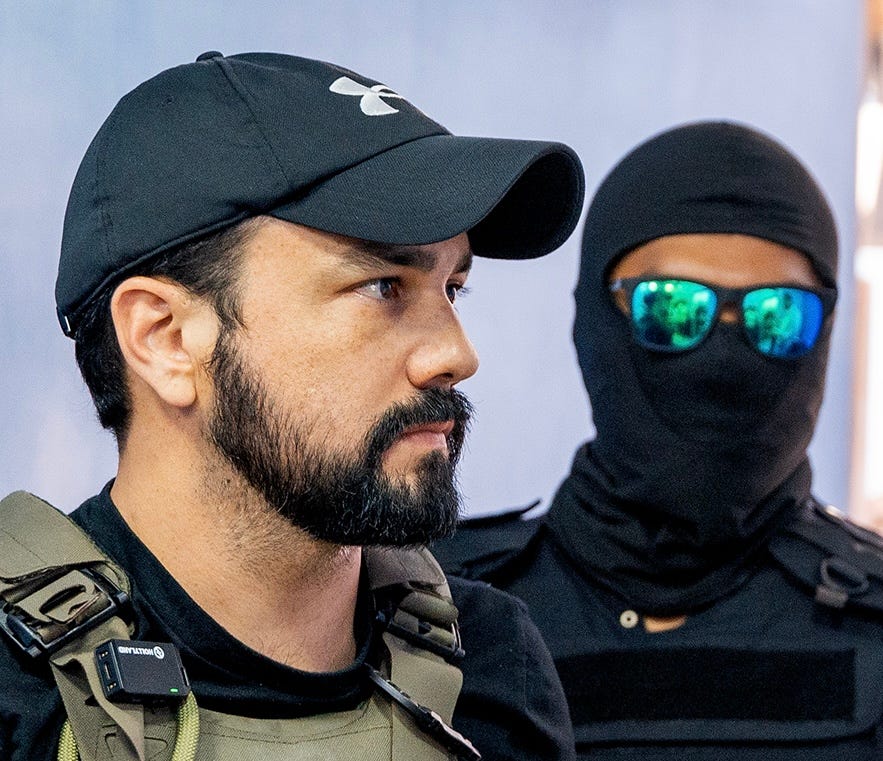
One morning in May 2023, newly-elected mayor Luis Chonillo was part of a convoy of vehicles heading to convene the first meeting of the city council of Durán, a gritty city that sits across Río Guayas from Ecuador’s most populous urban conglomeration, Guayaquil. He almost didn’t make it.
Chonillo’s car was ambushed in an attack that killed two police officers and a bystander and injured several more. Earlier that day, Chonillo reported that he had found people at Durán’s city hall destroying municipal documents and CD records.
The same year as the attack on Chonillo, Durán, a city of some 300,000 people, was rated as “one of the most dangerous cities in the world.” Once known as a railway hub and a bedroom community for the larger Guayaquil, in recent years Durán has become better known for the vast influence various armed criminal groups there have exercised over the daily life of its inhabitants, with the Los Chone Killers and Latin Kings holding dominance over large parts of the city in recent years. [Readers can learn more about the dynamic in Guayaquil and Durán in my recent article here.]
After traveling back and forth between the United States and Durán in an attempt to both do his job and stay alive, Luis Chonillo is now more or less permanently working remotely from Florida even as he continues to serve as Durán’s mayor. Earlier this month, he responded to a series of questions I put to him via email, the answers to which can be read below. The interview has been translated from Spanish and lightly edited for clarity.
You have served as mayor of Durán for three years. During this time, not only the city, but the entire country, has experienced a drastic decline in security. How has this affected the daily lives of Durán’s residents? How has it influenced your performance as mayor?
Being mayor in this context has been, above all, an act of resistance. The deterioration of security isn’t just measured in numbers, it’s measured in the silence of the streets. In Durán, commerce hasn’t just changed, it’s retreated. The person who used to sell fries and sausages until midnight now has their shutters down by 9 p.m. It’s not a choice, it’s a forced adaptation. We’ve gone from a dynamic economy to a survival economy, where hours are dictated by fear, not demand. The most dangerous thing is that society, in its eagerness to protect itself, is creating a defense mechanism that ends up being a trap. By adapting to the restrictions imposed by criminals, we are accepting their “roadmap.” We are allowing organized crime to dictate the rules of coexistence, submitting to an order that is alien to us.
I am deeply concerned about how this environment permeates even cultural consumption and information…Even on a personal level, I watch with astonishment as this phenomenon reaches generations we considered immune, like my parents’. People with strong values and analytical skills are being seduced by the fragmented reality of screens, losing that critical and investigative sense that the leisurely reading of a newspaper once provided.
If you ask me how this has influenced my performance, my answer is clear: It has tested my capacity for survival and adaptation. My administration has been, quite literally, a challenge to the traditional logic of politics.
The public should know something: I haven’t sat in the mayor’s office chair a single day. From the first day, after the attack, I was forced to govern remotely. I’ve had to manage a complex city without the physical proximity of the territory, building trustworthy teams through a trial-and-error process. I’m self-critical. The distance has caused me to make mistakes that perhaps I would have corrected more quickly if I were on the ground, but it has also forced me to be a more astute professional, always looking to correct mistakes and build on successes.
Ecuador is spoiled by the populist inauguration style. There’s a belief that if the mayor isn’t cutting a ribbon, he’s not working. I’m breaking with that view. My job is to ensure Durán moves forward, that the work gets done, and that the problem is solved. My job isn’t to make a spectacle of every sidewalk or park we deliver. Every penny spent on communication to inflate the image of the mayor is a penny taken away from real investment.
My greatest contribution as mayor is to guarantee that the institution doesn’t stall, that planning continues, and that, despite the threats, Durán keeps moving forward day after day.
Just after your inauguration as mayor, you survived an assassination attempt that left several people dead. Even today, your life is in danger. Which individuals or groups do you believe are behind these attacks, and why do they perceive you as a threat?
My arrival at the Mayor’s office represented a break with the past. Undoubtedly, these attacks came from groups that were already entrenched within the municipal structure and who understood, from day one, that they would have no place with me. I became an uncomfortable figure because my commitment was not to power quotas, but to transparency.
We did not stand idly by. Thanks to inter-institutional collaboration and intelligence information, we were able to accurately determine the alarming level of infiltration that existed within the municipal offices. The perception of threat against me grew when I decided to move from identification to action. That unease I mentioned translated into firm decisions. That’s why we implemented coordinated interventions in critical areas that had historically been vulnerable: the Transit Agency, the Fire Department, the Property Registry and the municipal government itself.
They perceive me as a threat because we are dismantling the mechanisms that allowed public resources to be used for nefarious purposes. My life is in danger because I decided that the municipality of Durán should once again belong to the citizens and not to those who sought to govern it from the shadows.
How would you rate the national government’s response to the security crisis in Durán? Effective or ineffective? What does the city need to achieve a certain level of peace?
Rather than categorizing the national government’s response as effective or ineffective at this moment, I prefer to see it as an ongoing process whose final evaluation will depend on the sustainability of its results. Security is not a one-off event, but a daily, ongoing effort.
Our position has been one of absolute support. We haven’t limited ourselves to observing; we have been active facilitators. When the armed forces intervene in Durán, the municipality guarantees all the logistical conditions for their deployment, from the physical spaces for their quarters to the necessary facilities to ensure their operations are real and not just symbolic.
There are results, and the key lies in refining the coordination mechanisms. We have supported the National Police in various ways, maintaining constant working groups because we understand that security is an inter-institutional effort. My role as mayor is to ensure that this process continues. True security will only be achieved when we make the State’s presence stronger and more appealing than any parallel structure. For our part, our support for the central government is and will remain unwavering, as long as the goal is peace for every family in Durán.
How will the city of Durán and Ecuador be able to emerge from this crisis? What measures are necessary?
For Durán and Ecuador to overcome this crisis, we must understand that there are no magic or immediate solutions. The way out requires a dual approach: The firmness of the State and the sensitivity of social investment. The State can never relinquish control of the territory, but that control must be accompanied by a helping hand. We need people to regain faith in their institutions because these deliver tangible results. True recovery begins with the family and massive social investment. Infrastructure is development, but the education of new generations is what guarantees that this process is sustainable over time.
We must look at the world realistically. Italy did not completely eradicate the Cosa Nostra, but it managed to control it and subject it to the rule of law. Medellín needed almost a decade of a comprehensive process to transform itself into a benchmark for tourism and development. These experiences teach us that the judicial system must be an unwavering ally in the fight against impunity. It is not a short path, and anyone who says otherwise is lying. It is common to try to import El Salvador’s model in a simplistic way. While there are lessons that can be useful, we must understand that our reality is different. In Ecuador, we face transnational organized crime and cartels with a deep capacity for infiltration.
Furthermore, we face a complex social problem, entire families who have ended up depending on illegal economies due to a lack of alternatives. Therefore, Durán’s model cannot be solely about repression. It must be a model of economic substitution. We must offer an economy of legality and progress that is stronger and more attractive than crime. The way out of this crisis is not a populist slogan. It is a work of resistance lasting at least a decade, where territorial control, a courageous justice system, and deep social investment in our children are the pillars that will restore our peace.
What measures are you taking to try to restore security in Durán?
It is vital that citizens understand how responsibilities work. Security is a direct responsibility of the Central Government. However, in Durán, we don’t use that as an excuse for inaction. For us, security is as vital as health. It is the engine of our city’s development, and therefore, we are active participants in this process.
We are establishing ongoing collaboration with the National Police and the Armed Forces. I am the first to say that they need more resources, and while the central government provides them, we are investing in upgrading our security camera system. These are not only prevention tools but also key elements for criminal investigations that facilitate the work of the justice system.
Our strongest investment is in people. We are working very closely with families, reclaiming spaces through sports and social programs aimed at children, youth, and senior citizens. The objective is clear: To take our youth away from crime.
The recovery of critical areas, such as Cerro Las Cabras, is the best example of what we need. The municipality can and wants to intervene with brigades, cultural initiatives, and services, but we cannot do it alone. Police intervention must be a permanent presence to guarantee control. Municipal support then comes in the form of sustainable social programs.
We cannot send our officials to high-risk areas without the protection of law enforcement…Peace in Durán will only be possible if the State’s territorial control and the Municipality’s social management go hand in hand, without retreating an inch.
Can you explain your decision to work from the United States while remaining mayor of Durán?
Following the attack on my inauguration day, I was forced to make an absolutely urgent decision: To move my family to secure locations abroad. Initially, my work involved constant back-and-forth travel. However, given the increase in real threats against our safety, I now manage my administration under strict security protocols outside the country.
This is not a choice of comfort, but of strategy and survival, so that I can make the key and courageous decisions that Durán needs, such as continuing to purge a municipality I inherited riddled with people close to criminal groups. My commitment is to the city, and to fulfill it, I must ensure that my voice and my ability to act are not silenced by violence.
Finally, I share a deep concern regarding the upcoming local elections. My greatest wish is that future mayors do not have to face the situation I am in today, where serving a city means putting their own lives and the lives of their loved ones at risk.
What would you like people abroad to understand about the city of Durán and its people?
What I most want the world to understand is that Durán is not defined by its violent statistics. We are a city with a deep history, a vibrant culture, and tourism potential that fear has tried to hide, but has not been able to erase.
It’s true, the numbers have been stark. In 2024, we were ranked as one of the most violent cities in the world. But today, that reality is changing. We have managed to drop drastically in that ranking, currently placing us around 80th. If we maintain this management model and this same trend of control and firmness, I am convinced that in a couple of years we will be a transformed city.
My aspiration is to consolidate what I call ‘Peace Points.’ I envision clearly identified parks, markets, and hospitals—perhaps with a white flag alongside our city’s flag—where control is total. These will not only be spaces monitored by cameras, but spaces protected by the community. We want to reach a point where any attempt to violate these spaces not only receives an implacable legal sanction, but also a social one, where the citizens themselves repudiate and expel the perpetrator because they have reclaimed their sense of belonging to their space.
I would like the world to see us as an example of a city that was on the brink of collapse and decided to rise again. I want them to see a people who aspire to progress, who value their safety, and who are working every day so that Durán stops being in the news for its suffering and starts being in the news for its recovery.
We are a city that is healing, and our greatest project is for peace to cease being a mere aspiration and become our very identity.
What future would you like to see in Durán over the next two or three years?
If I envision Durán over the next two or three years, I don’t see a city of empty promises, but a city with solid foundations. My priority isn’t the photo op at the inauguration, but the responsibility of getting things started.
I’m focused on getting the drinking water project underway. It’s a long-standing and painful debt owed to our people, who can’t wait any longer. I don’t have the political ambition of being the one to inaugurate the project to garner applause. My true goal is to be the one who sets the process in motion, ensuring that the path toward basic dignity for the people of Durán is irreversible.
When I hand over my term, my greatest pride will be leaving behind a healthy municipality. I inherited a bankrupt institution, burdened by crippling debt and facing legal and financial problems at every turn. Now I envision a financially stable municipality, an administration that has ceased to be a problem and has become the solution.
I dream that, in a couple of years, once we’ve consolidated the ‘Peace Points,’ Durán will be a benchmark for institutional management. That the world will ask: ‘How did they manage to pull a city that seemed lost back on its feet?’
As happened in Medellín after the intervention in Comuna 13, drastic processes take time. I won’t be here in 15 years as mayor, but if God grants me life and the administrations that follow are responsible, they’ll be able to say: ‘Here, someone had the courage to begin the transformation.’ My success won’t be measured by the years I remain in office, but by the strength of the foundations we are building today for future generations.
I hope he gets the opportunity to see his work through to the results he looks toward.